
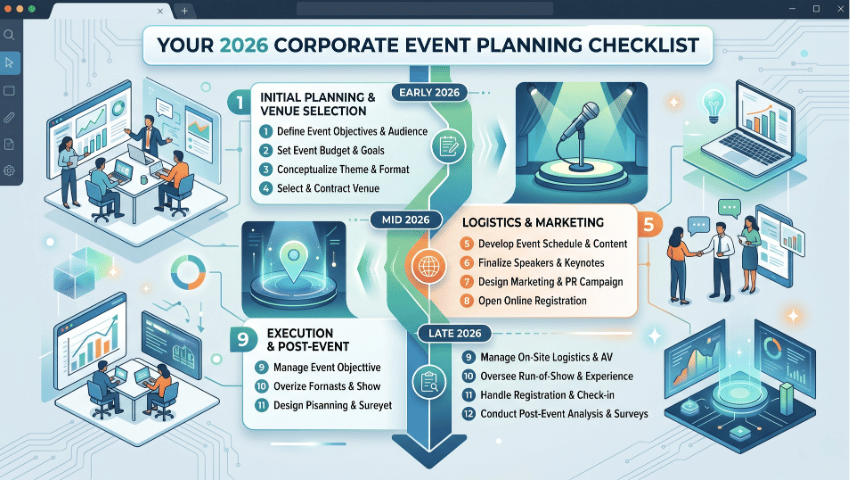
Planning a business event in Bangalore often starts with a neat brief and a confident deadline. Then, almost immediately, the details multiply. The venue needs to suit the audience. The AV plan has to be reliable. Guest movement, seating layout, catering, parking, and timing all need attention at once. That is exactly why a strong Corporate Event Planning Checklist matters. It helps teams move from scattered decisions to a clear plan, with fewer surprises and a much smoother event day.
For corporate organisers, the challenge is rarely one big issue. It is the build up of smaller ones that get missed until the final week. This guide brings those moving parts together so you can plan with more confidence, compare venues more clearly, and execute your event with far less stress.
Why end to end planning matters
A corporate event can look simple from the outside. Book a hall, send invitations, confirm lunch, and get started. In practice, the event experience depends on how well each element connects to the next.
A venue may be impressive, but if registration backs up at the entrance or the screen is hard to read from the last row, the event starts to lose momentum. A polished schedule can also fall apart if catering service clashes with session timings. End to end planning helps ensure a smooth experience because it treats the event as one connected journey.
What strong planning changes
When the full flow is considered early, organisers can:
- make event planning easier across teams
- support better guest engagement
- help avoid last minute challenges
- improve budget accuracy
- reduce vendor confusion on event day
For example, an annual leadership meet for 200 guests in Whitefield needs different planning from a training session for 60 attendees in JP Nagar. The event goals may both be corporate, but the venue format, seating, technical setup, and guest expectations can be very different.
The practical takeaway
The more moving parts your event has, the more valuable a structured planning process becomes. Start with the whole event journey, not just the venue search.
How to choose the right venue in your Corporate Event Planning Checklist
Venue selection shapes almost everything else. It influences attendance, comfort, technical quality, branding, and how professionally the event is perceived.
Start with the event format
Before shortlisting a corporate event venue in Bangalore, define the event type clearly. A board meeting, product launch, annual conference, awards evening, and training workshop all need different environments.
Think about:
- expected guest count
- session style
- need for stage presence
- breakout requirements
- dining format
- technical complexity
A company town hall for 300 guests may work best in an auditorium or larger convention space. A strategy session for 80 delegates may be better in one of the more flexible corporate event spaces or banquet halls with presentation support.
Check location and access
Bangalore traffic can change the success of an event before the first speaker even arrives. Choose a venue that suits where your guests are travelling from.
A conference venue in Whitefield may be ideal for eastern business districts and technology parks. A centrally connected or South Bangalore venue may be easier for mixed city attendance. Parking, drop off access, and clear navigation all add convenience for organisers and attendees alike.
Evaluate venue infrastructure properly
Do not stop at décor and square footage. Check how the venue performs under real event conditions.
Review:
- hall capacity in your preferred layout
- screen visibility
- sound quality
- power backup
- registration area
- green room or speaker prep areas
- restroom access
- loading access for vendors
A venue such as MLR Convention Centre fits naturally into this conversation because it combines spacious convention halls, auditoriums, corporate ready facilities, and professional event support in one setting. That kind of setup makes event planning easier when you need both scale and operational confidence.
Corporate Event Planning Checklist for budget planning
Budget pressure usually appears early, but poor budget planning tends to show up late. That is when hidden requirements start appearing all at once.
Build the budget in layers
A more reliable event budget includes:
- Venue hire
- AV and technical setup
- Catering
- Branding and stage design
- Guest logistics and registration
- Photography or event coverage
- Contingency allowance
For smaller internal events, costs may stay relatively controlled. For larger conferences or annual meets, expenses rise quickly once production, hospitality, and branding are added.
Broad budget guidance
In Bangalore, the cost of a business event can vary widely depending on venue type, guest count, and production needs.
As a general guide:
- compact business meetings and workshops may begin at a modest venue and catering budget
- mid sized conferences for 100 to 250 attendees usually require more structured spending across hall rental, AV, and food service
- larger annual gatherings in premium venues often need a broader allocation for stage design, registration support, and event execution support
The practical takeaway
Compare full event cost, not just venue hire. A lower base rate can become expensive if essential services are missing.
AV and technical setup can make or break the event
Technical planning deserves far more attention than it usually gets. Guests may forgive a delayed coffee break. They are less forgiving when the mic cuts out during the keynote.
What to confirm early
Your AV plan should cover:
- number of microphones
- screen size and placement
- projector or LED requirements
- speaker clickers
- confidence monitor if needed
- laptop connection compatibility
- internet support
- recording or live stream requirements
For a product presentation in a conference venue, strong visibility and sound are non negotiable. For panel discussions, stage audio and seating comfort matter more than visual spectacle.
Test for the room, not just the equipment
A good sound system in the wrong room still creates problems. The same goes for screens that are technically large enough but poorly positioned for the audience.
A proper walkthrough helps ensure a smooth experience because it lets organisers check the setup against the actual hall layout.
The practical takeaway
Always schedule a technical rehearsal. It is one of the simplest ways to help avoid last minute challenges.
Seating and stage layout affect engagement more than people expect
The same guest count can feel energised in one layout and disconnected in another.
Corporate Event Planning Checklist for seating and stage layout
Match layout to purpose
Choose the seating format based on how people will engage.
Common options include:
- theatre style for presentations, launches, and keynote sessions
- classroom style for training and note taking
- cluster seating for workshops and team discussions
- banquet seating for recognition events and formal dinners
For 50 guests, almost any room can seem manageable. For 300 guests, layout becomes critical. Sightlines, aisle spacing, and stage visibility all support better guest engagement.
Keep the stage practical
A stage should suit the programme, not just the photograph. Ask:
- Will there be one speaker or a full panel?
- Is there space for branding without crowding the stage?
- Can presenters enter and exit smoothly?
- Is the lectern placed well for visibility?
The practical takeaway
A beautiful setup is useful only if the audience can see, hear, and follow the programme comfortably.
Guest logistics and accessibility need early planning
Guests notice friction quickly. Long queues, confusing directions, or difficult access can make even a premium event feel disorganised.
Plan the guest journey
Think through the experience from arrival to departure:
- entry and registration flow
- signage inside the venue
- parking support
- lift or step free access where needed
- waiting areas for early arrivals
- clear movement between sessions and dining
This matters even more for mixed groups that include senior leaders, clients, external delegates, or older attendees.
Bangalore specific planning matters
If your event is in Whitefield, allow extra travel buffer for city wide attendees. If it is in JP Nagar, communicate the best access routes and parking details in advance. Good communication adds convenience for organisers and attendees alike.
The practical takeaway
Accessibility is not just a facility issue. It is part of the guest experience and should be planned as such.
Catering and breakout planning support the event flow
Food service often shapes the mood of a corporate gathering more than people expect. Good catering feels seamless. Poor timing creates drift.
Plan meals around the programme
Think about:
- tea and coffee timing
- buffet capacity
- dietary preferences
- service speed
- breakout room access
- networking space during meal periods
For day long conferences, poorly planned breaks can create congestion and delay the next session. For leadership meets, dining quality often influences the overall impression of the event.
Use breakouts with purpose
Breakout areas can support workshops, smaller discussions, media interviews, or private leadership conversations. They are especially useful in larger conference facilities where not every moment should happen on the main stage.
The practical takeaway
Catering and breakout spaces should support the programme rhythm, not interrupt it.
Timeline and vendor coordination keep execution on track
A strong run sheet can save an average event. A weak one can damage a good venue.
Build a realistic event timeline
Your timeline should include:
- vendor arrival times
- registration opening
- AV checks
- speaker reporting
- catering service windows
- session transitions
- closing and exit planning
Do not stack the day too tightly. Small delays are normal. Good planning leaves room for them.
Coordinate vendors through one point of contact
Photographers, decorators, AV teams, hosts, caterers, and venue staff all need alignment. One clear coordinator helps ensure a smooth experience and reduces confusion.
The practical takeaway
Execution improves when every vendor works from the same schedule and the same event priorities.
Mistakes to avoid
Even experienced organisers repeat a few common errors.
Watch for these issues
- choosing a venue before confirming the event format
- underestimating technical requirements
- ignoring travel time and parking
- using the wrong seating layout
- leaving catering decisions too late
- skipping the venue walkthrough
- not assigning one event lead
Each of these can seem minor in isolation. Together, they create avoidable pressure in the final days.
A practical checklist before booking
Use this Corporate Event Planning Checklist before confirming your venue and final event plan.
Venue checklist
- Is the venue suited to the event type and guest count?
- Are the conference facilities, halls, or auditorium appropriate for your format?
- Is the location convenient for your audience?
- Are parking and accessibility strong enough?
- Does the venue offer reliable AV support and power backup?
- Are breakout spaces available if needed?
Event planning checklist
- Has the budget been built beyond venue hire?
- Is the seating format matched to the event goal?
- Have catering timings been aligned with the agenda?
- Are vendors working from one shared schedule?
- Has a technical rehearsal been planned?
- Is there clear event execution support on site?
Final thoughts
A successful corporate event rarely comes from one great decision alone. It comes from many well connected choices, made early and reviewed carefully. The right Corporate Event Planning Checklist helps organisers move from venue selection to execution with more clarity, better timing, and fewer avoidable problems.
If you are planning a business event in Bangalore in 2026, use this framework to compare venues, refine your budget, and stress test your event flow before booking. A venue with strong infrastructure, accessible location, and experienced support can make a meaningful difference, especially when the goal is a polished event that runs smoothly from first guest arrival to final session close.